what is the long-term consequence if we continue to cut down on the forest?
This article was originally published on Global Woods Review.
The tropics lost 12.2 million hectares of tree cover in 2020, according to new data from the University of Maryland and available on Global Forest Watch.
Of that, 4.ii 1000000 hectares, an surface area the size of holland, occurred inside humid tropical main forests, which are particularly important for carbon storage and biodiversity. The resulting carbon emissions from this primary wood loss (2.64 Gt CO2) are equivalent to the annual emissions of 570 meg cars, more than double the number of cars on the road in the The states.
Master forest loss was 12% higher in 2020 than the year before, and it was the 2nd yr in a row that primary forest loss worsened in the tropics.
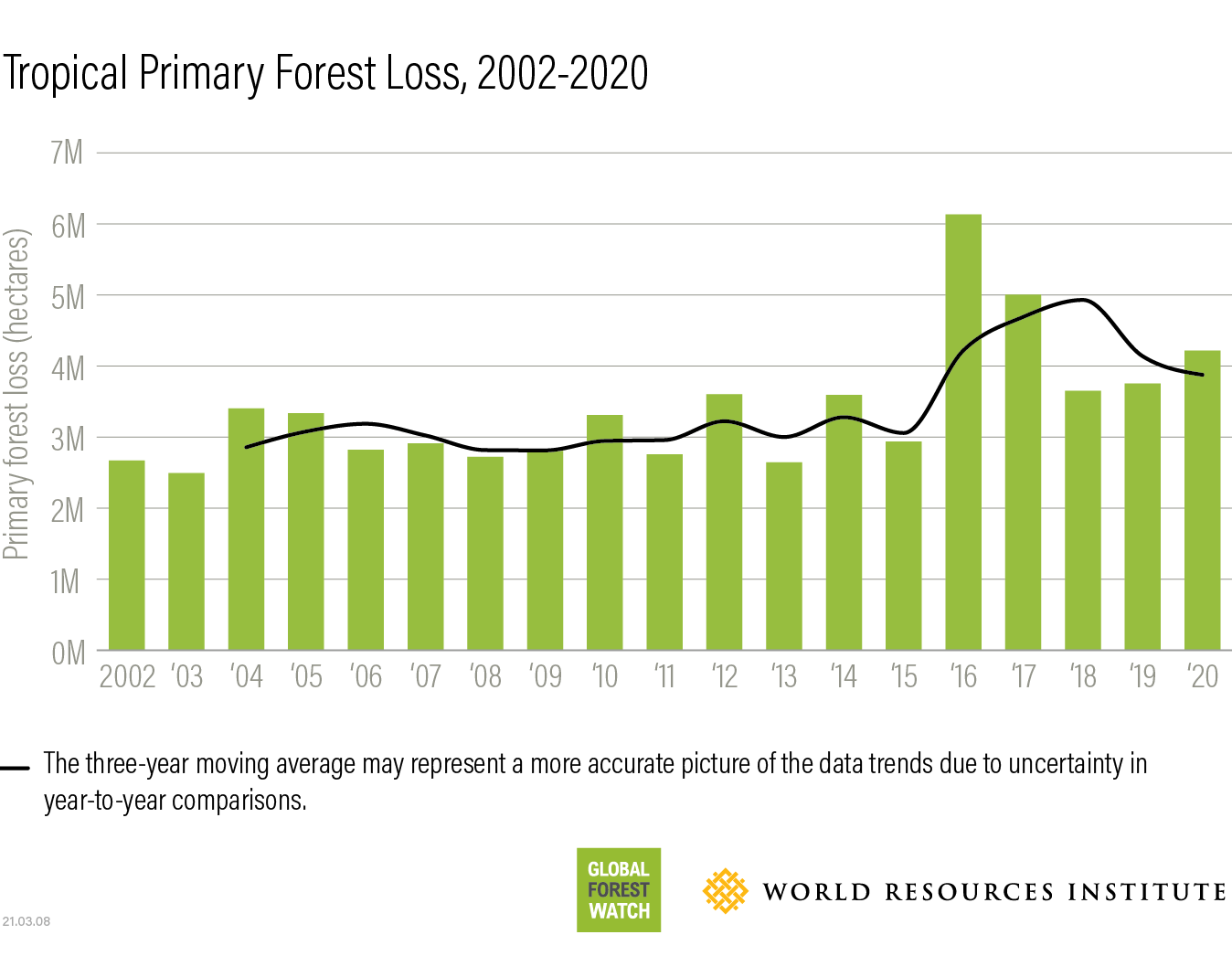
2020 was meant to be a landmark year in the fight against deforestation – a year past which many companies, countries and international organizations had pledged to halve or completely stop wood loss. Continued losses of primary tropical forests make it clear that humanity has fallen short in coming together these targets.
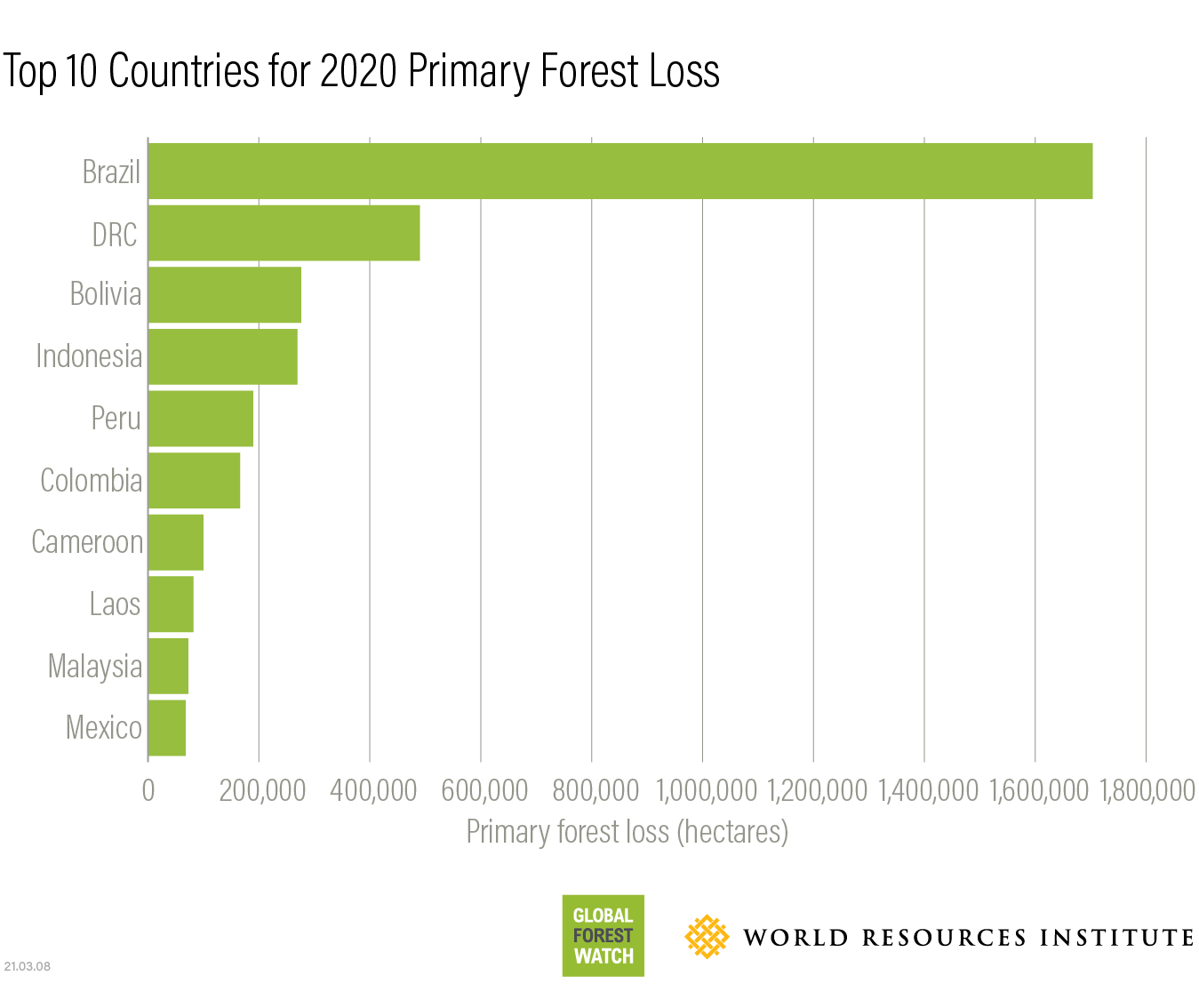

As in by years, commodity-driven deforestation was the leading cause of tree cover loss (both in primary and secondary forests) in Latin America and Southeast Asia, while shifting agriculture dominates in tropical Africa. In addition, fires and other climate-related impacts connected to play a big office, both in the tropics and across.
Here's a deeper look at some of the trends in forest loss in 2020:
Vivid spots of hope for forests in Republic of indonesia and Malaysia
While global deforestation numbers are deplorable, progress in Southeast Asia offers a bright spot.
Republic of indonesia'due south rate of primary forest loss decreased for the fourth yr in a row in 2020, one of only a few countries to do so. Indonesia also dropped out of the top three countries for chief woods loss for the first fourth dimension since our tape-keeping began.
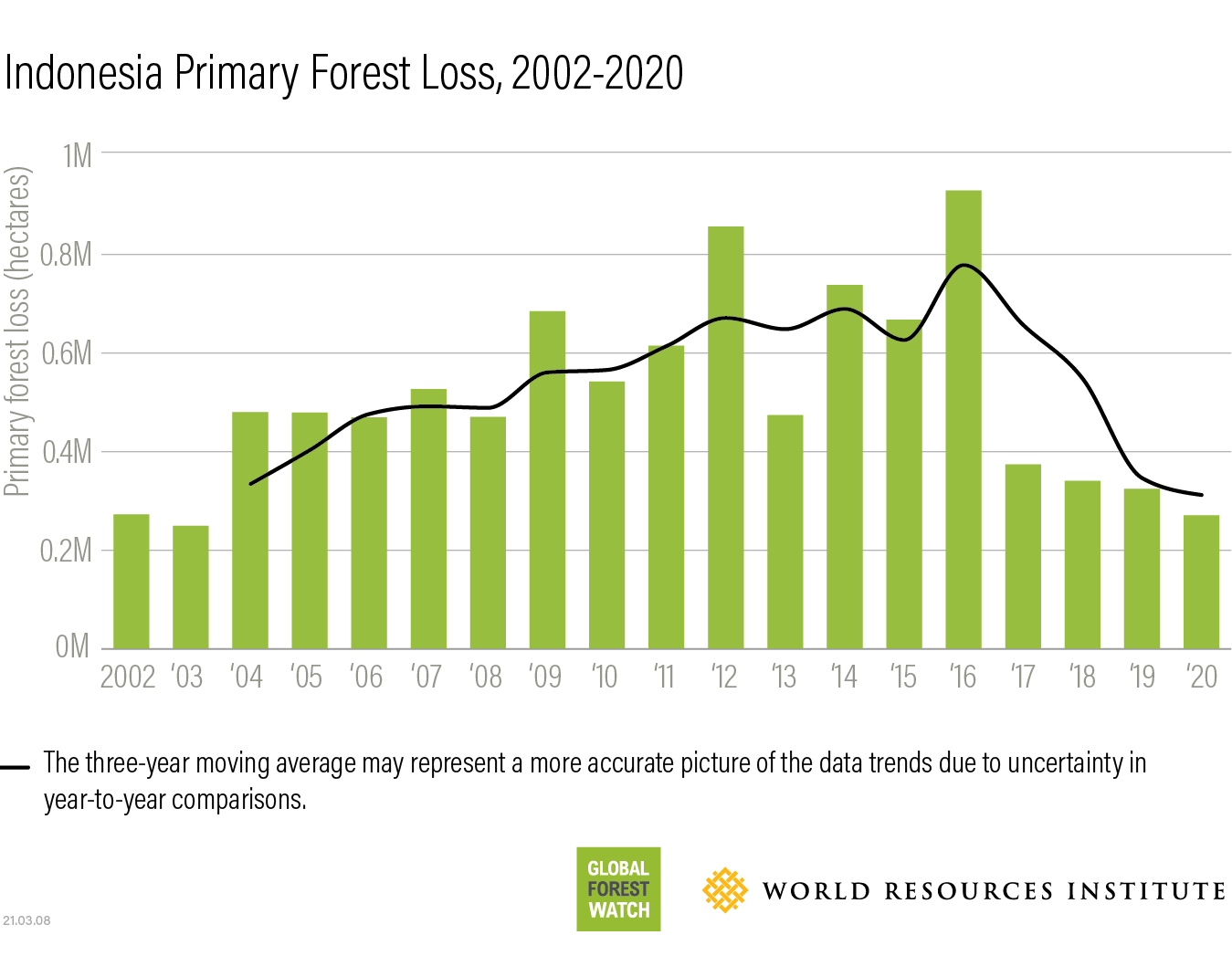
A number of national and subnational initiatives appear to be having a long-term effect on reducing chief wood loss. After devastating forest and peat fires in 2015, Indonesia'south Ministry of Environment and Forestry stepped up its fire monitoring and prevention efforts. The government issued a temporary moratorium on new oil palm plantation licenses and a permanent moratorium on primary woods and peatlands conversion.
Agrarian and social forestry reforms have eased pressures on forests past alleviating poverty and encouraging sustainable land use. The mandate of the Peat Restoration Agency, responsible for protecting and restoring carbon-rich peatlands, was extended in 2020 and now includes mangrove forests, an of import ecosystem for biodiversity and reducing the bear on of extreme weather condition. Many subnational governments also recently made sustainable land utilize pledges backed by regulations that could adjourn deforestation going frontward.
Chief forest loss also declined in Malaysia for the quaternary year in a row. While this recent trend is good news, Malaysia has lost nearly a fifth of its master forest since the year 2001; up to a 3rd since the 1970s. The more recent downwards trend and government actions are promising for conservation of remaining forests. Malaysia established a five-year cap on plantation area in 2019 and plans to toughen forest laws by increasing fines and jail terms for illegal logging.
In addition to government initiatives to curb master wood loss in Indonesia and Malaysia, corporate commitments in the pulp and paper and oil palm sectors may too exist reducing deforestation. No Deforestation, No Peat and No Exploitation (NDPE) Commitments now cover over fourscore% of the pulp and paper industry in Indonesia and 83% of palm oil refining capacity in Indonesia and Malaysia. The Roundtable on Sustainable Palm Oil tightened sustainable certification requirements in 2018 to include a ban on whatever deforestation or peatland immigration.
Building on Indonesia'due south and Malaysia's progress
While there is reason to celebrate this refuse in primary wood loss, Republic of indonesia and Malaysia must do more to strengthen existing policies to ensure this trend continues, including extending the oil palm plantation license moratorium which is set to expire in 2021. Regional climate and market weather condition too may have reduced pressure level on forests — conditions that could shift and, without the right measures in place, undo progress.
Wet conditions in 2020 helped prevent the spread of fires that tin burn down out of command in dry weather years. Rough palm oil prices, which are correlated to Indonesia'southward spikes in forest loss in 2009 and 2012, are back up to 2012 levels after a slump. Fire-monitoring efforts and NDPE commitments will play an important office in preventing future upticks in master forest loss when climate and market conditions shift.
Coronavirus pandemic relief measures could likewise negatively touch on forests in Republic of indonesia. In the wake of COVID-19, Indonesia accelerated and passed the Omnibus Law to spur task creation and economic growth, which could jeopardize forests by relaxing environmental regulations. Republic of indonesia also launched the food estate program to address potential food shortages related to the pandemic, which is exempt from the forest moratorium and puts peatland and protected forests in Key Kalimantan at risk through the establishment of new farmland for rice and other staple crops.
Unfortunately, the downward trend in principal forest loss in Republic of indonesia and Malaysia is not visible in other Southeast Asian countries. Cambodia, Laos and Myanmar continue to see sustained or increasing levels of primary woods loss.
Brazil leads the earth in primary woods loss, due to fires and clear-cutting
Brazil again topped the list for annual primary forest loss with a total loss of 1.7 1000000 hectares in 2020, more than three times the next-highest state. Principal woods loss in Brazil increased by 25% in 2020 compared to the year before.
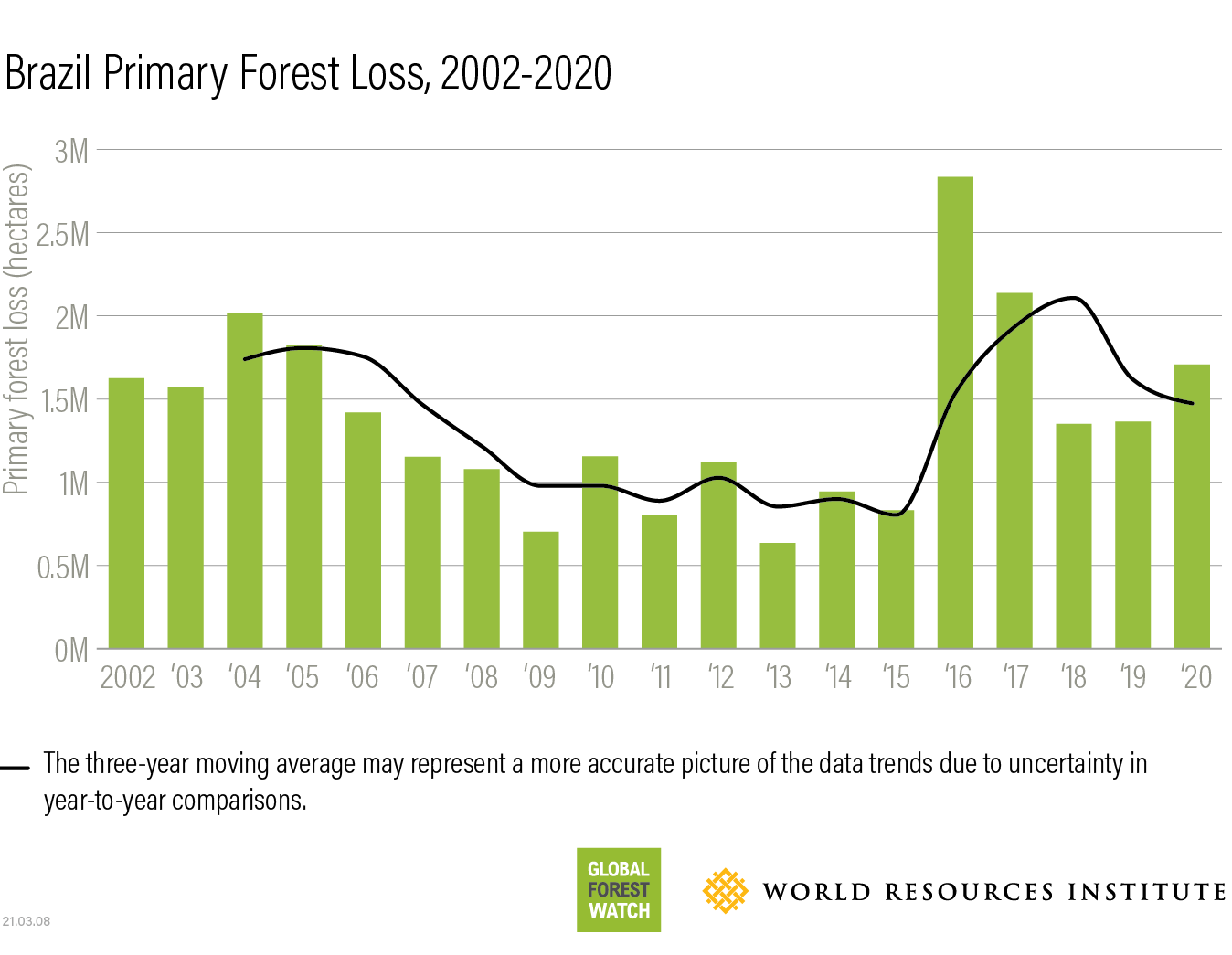
The majority of boiling chief woods loss in the country occurred in the Brazilian Amazon, which saw a fifteen% increase from last year, for a total of one.5 million hectares. This matches the trend seen in government information, which specifically tracks big-scale clear-cuts in the Amazon (read more about the deviation between these two information sources here). Newly cleared patches are particularly prevalent along the Amazon's southern and eastern edges (known as the "arc of deforestation") and forth highways bisecting the Amazon rainforest, several of which are slated for expansion and paving in the coming years.
The information also shows a number of burn scars. The Brazilian Amazon had an fifty-fifty greater number of fires in 2020 than in 2019. This is apropos, as large fires rarely occur naturally in humid tropical forests like the Amazon.
In 2019, almost fires occurred on already-deforested areas as farmers prepared land for agriculture and cattle pastures. In 2020, even so, a significant share of the fires burned within forests as human-lit fires escaped beyond their intended extent due to dry weather.
Greenhouse gas emissions from woods fires in the Amazon have at times outstripped those from articulate-cut deforestation. Scientists fear that fires and associated emissions may increment in the future as climate change and further deforestation dry out out forests and brand them more than vulnerable to burn. The resulting positive feedback loop could potentially transform the Amazon into a savannah.
The high level of deforestation and burn down action in the Amazon happened despite a ban on fires during the top of the season and military machine deployment to curb illegal deforestation. That deployment is scheduled to terminate on April 30, 2021, with responsibility returning to federal enforcement agencies facing reduced budgets in 2021. The Amazon wasn't the simply biome in Brazil to experience an increase in humid primary forest loss in 2020, either. While only a small part of the land's overall loss, the Pantanal, the globe'due south largest tropical wetland, experienced 16 times more than principal forest loss in 2020 than the twelvemonth earlier.
The spike is due to record-breaking fires. As in the Amazon, most of the 2020 fires in the Pantanal were started by people to manage state, merely burned out of control in 2020 due to levels of drought not seen since the 1970s. Deforestation in other parts of South America may play a role in drying out the Pantanal, and climate change is likely to make extreme events happen more regularly.
Experts guess that effectually 30% of the Pantanal burned in 2020, including several protected areas. Several ethnic territories burned, leaving tribes like the Guató without food or clean water. The fires too had a devastating impact on biodiversity, with thousands of animals killed or injured every bit a effect of the blazes, including jaguars and other vulnerable species. While the long-term impact is unclear, the unprecedented nature of the fires means that some areas of the Pantanal likely won't recover for decades.
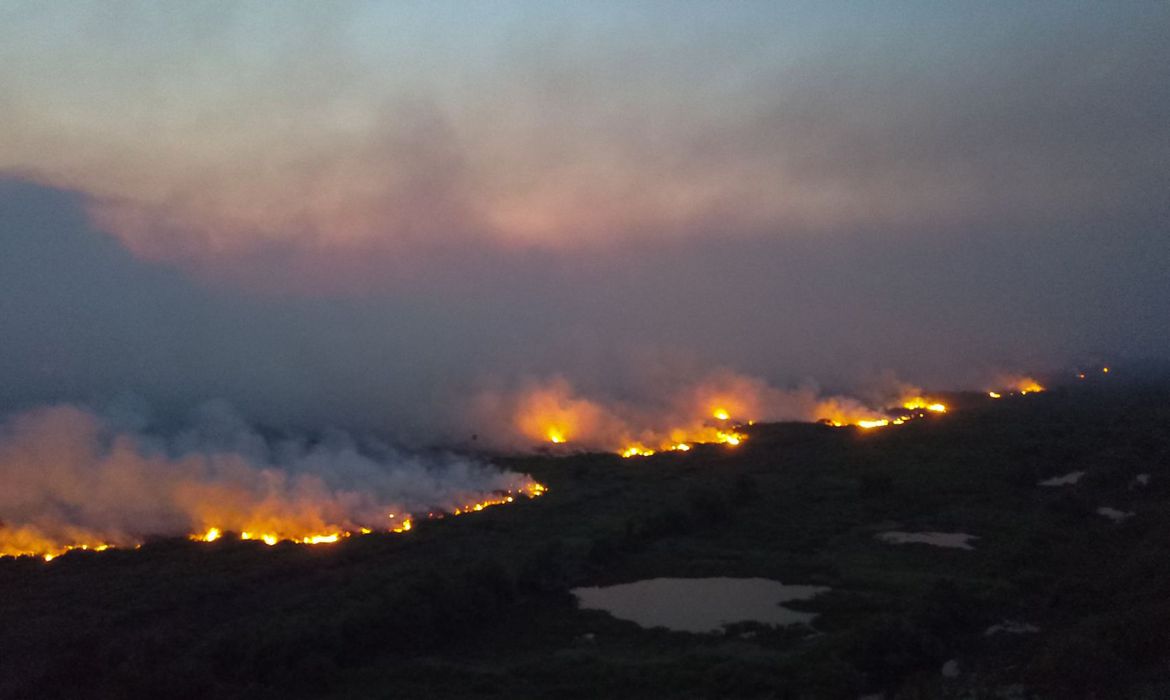 Fires burning in the Pantanal wetlands in 2019. Fires continued in 2020, leading to a huge spike in wood loss in the Pantanal. Photograph past Chico Ribiero/Governo Mato Grosso
Republic of bolivia, Colombia and Republic of peru see loftier levels of woods loss
Elsewhere in South America, forests have not fared much improve.
Despite a slight drop in primary forest loss from the year earlier, Bolivia rose to number three on the list of countries with the nigh humid tropical primary forest loss in 2020, passing Republic of indonesia for the first time. As in 2019, forest fires played a large part. Notably, the blazes affected several protected areas, including Noel Kempff Mercado National Park. Equally in Brazil, most of Republic of bolivia'south fires were likely prepare by people to articulate land, but raged out of control due to drought conditions and hot weather. Large-scale agriculture also afflicted forests, including numerous new clearings in the section of Santa Cruz.
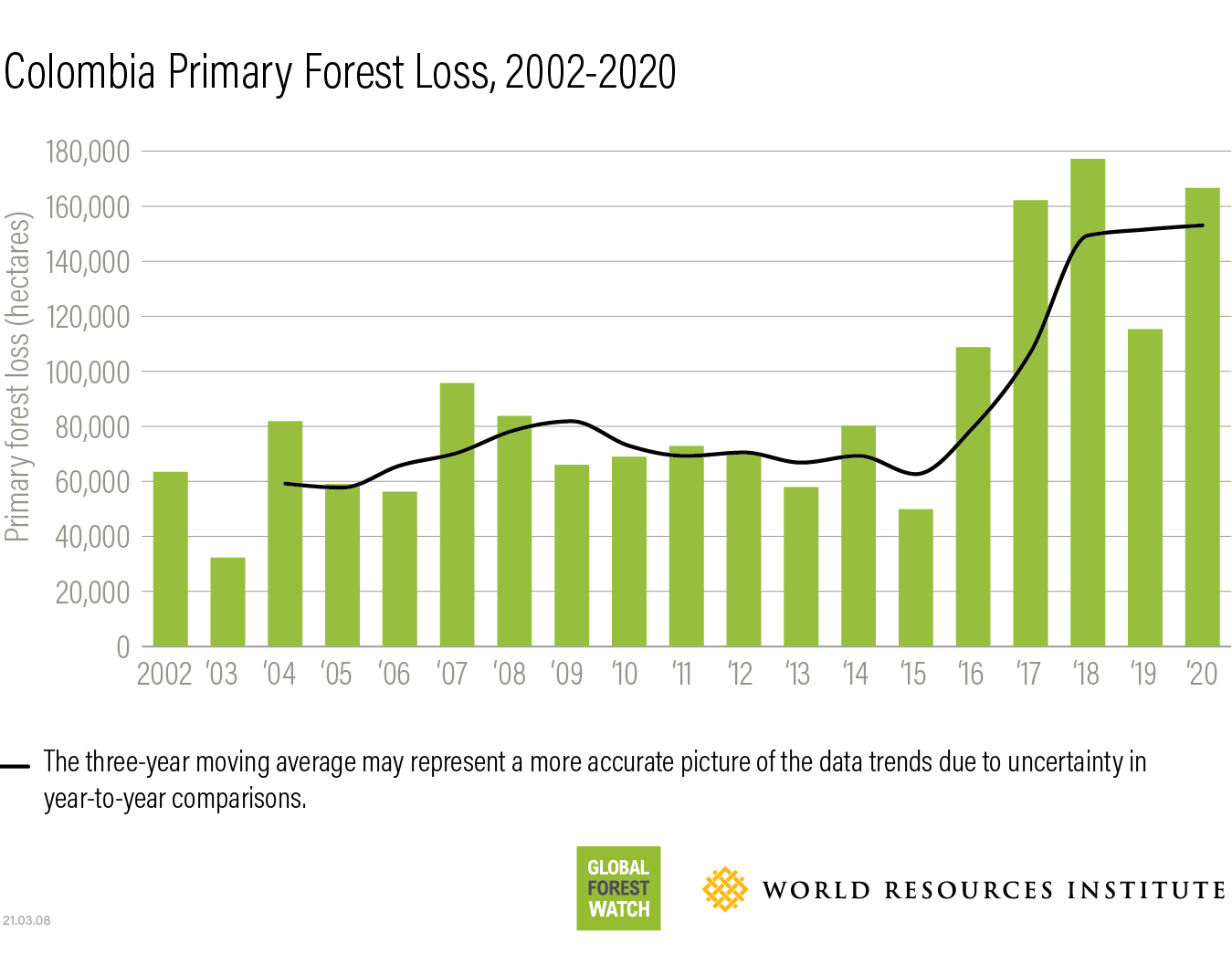
Meanwhile, in Republic of colombia, the charge per unit of primary forest loss rose in 2020 subsequently a dip the previous year.
Colombia has sustained high rates of chief forest loss since the government's 2016 peace agreement with the FARC, which led to a ability vacuum in previously controlled forest areas. While the 2019 information offered a glimmer of hope that the land might have been curbing primary forest loss, the rate in 2020 was support to levels seen in 2017 and 2018. Meanwhile, the government has publicly stepped up its appetite on deforestation, setting a goal of zero deforestation by 2030 equally part of its commitment to reduce greenhouse gas emissions by 51% over the same menstruation.
Deforestation continues to motion deeper into the Colombian Amazon rainforest, as well equally into several protected areas like Chiribiquete, Tinigua, and Sierra de la Macarena National Parks. Armed groups accept taken control in several of the land'southward protected areas. Staff were forced to leave ten parks in Feb 2020 due to threats to their prophylactic.
Republic of peru, in fifth place for most tropical woods loss, too saw high and increasing rates of wood loss in 2020. Much of the loss appears to be smaller clearings, probable for agronomics and cattle ranching. The information likewise shows a number of new logging roads throughout the Peruvian Amazon rainforest in 2020. The country has historically faced high rates of illegal timber extraction. Gold mining has also previously been a major driver of deforestation in the southern part of the country, but seemingly slowed in 2019 and 2020 cheers to government interventions.
Agriculture drives forest loss in Congo Basin
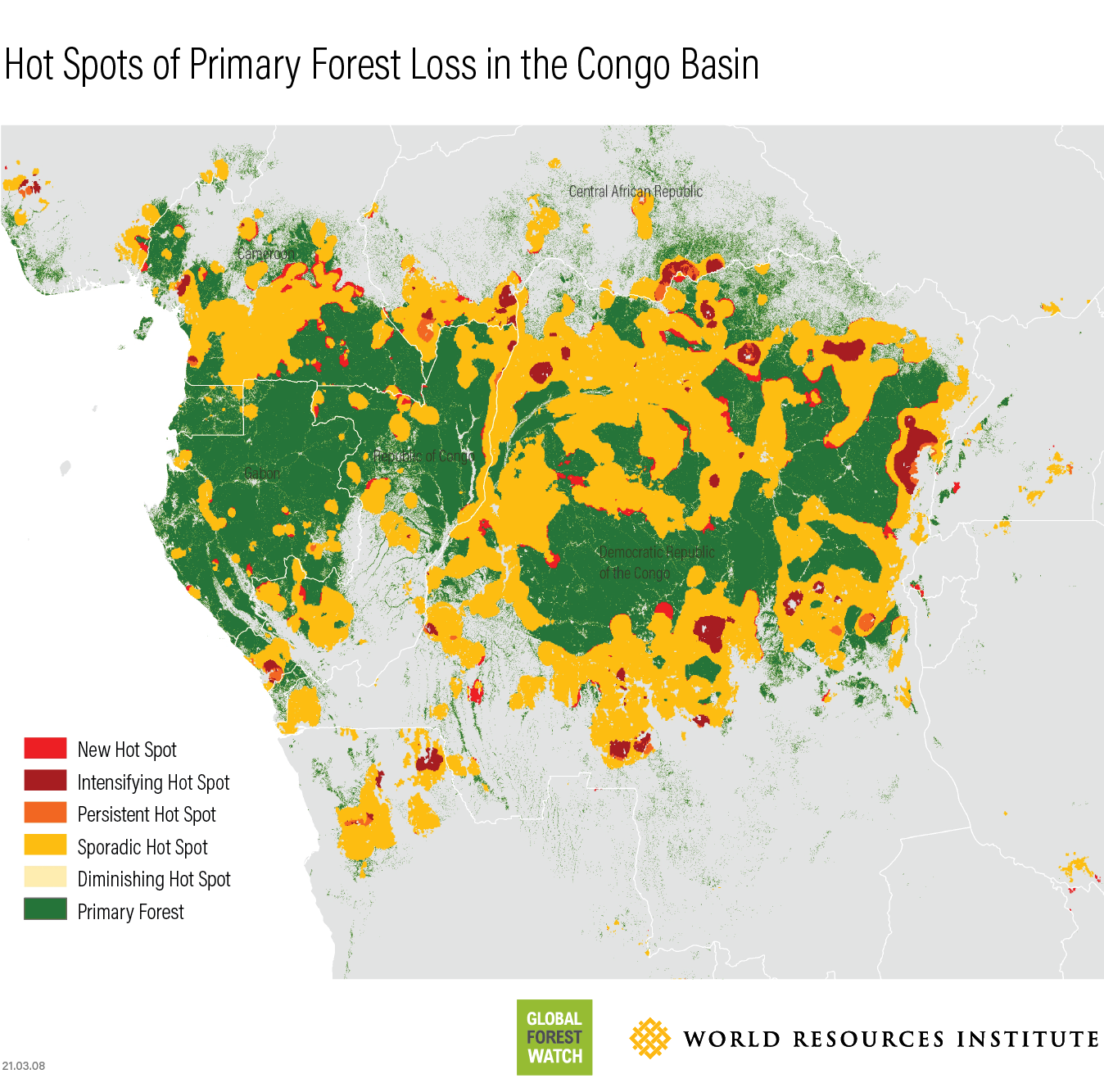
Rates of primary wood loss in Gabon, the Commonwealth of Congo, Primal African Republic and Republic of equatorial guinea accept all fluctuated in recent years, but loss increased dramatically in Cameroon, nearly doubling in 2020 compared to 2019. This increment was driven primarily by minor-scale shifting agriculture in the southern part of the state.
While it is difficult to pinpoint what is driving this agronomical expansion, information technology could be related to urban-rural migration related to pandemic task losses and increases in commodity prices, peculiarly cocoa and oil palm.
The Democratic republic of the congo (DRC) lost 490,000 hectares of main forest in 2020, the second-highest amount of any country subsequently Brazil. Equally in years past, the bulk of forest loss continues to exist caused past the expansion of pocket-size-scale shifting agriculture and wood free energy demands, including charcoal production.
More must exist washed past the DRC government as well every bit all local, national and international stakeholders to sympathise the underlying drivers of this loss and build capacity for solutions. Future primary wood loss can be prevented through improvements to agriculture practices and so that farmers tin can secure higher yields in areas already under tillage rather than convert primary forests to farmland. The restoration of degraded areas, sustainable logging practices, regulation of wood energy and access to make clean energy would also farther subtract pressure level on remaining forests.
What are the effects of climate change on forests?
In addition to the by and large human-caused loss in the above countries, forests too faced a multitude of climate-related disturbances in 2020, both in humid primary tropical forests and other tree embrace. Fires, fueled past regional droughts, have led to spikes in loss in places as diverse as the Brazilian Pantanal, Bolivia, Australia and Russian federation.
Meanwhile, storm and insect damage increased tree cover loss in Fundamental America and Central Europe, respectively. These dynamics underscore the dual-sided human relationship betwixt forests and climate change – non only do forests impact the climate by arresting carbon when growing and emitting it when cleared, they also can face up direct impacts as a upshot of changing temperature and precipitation patterns.
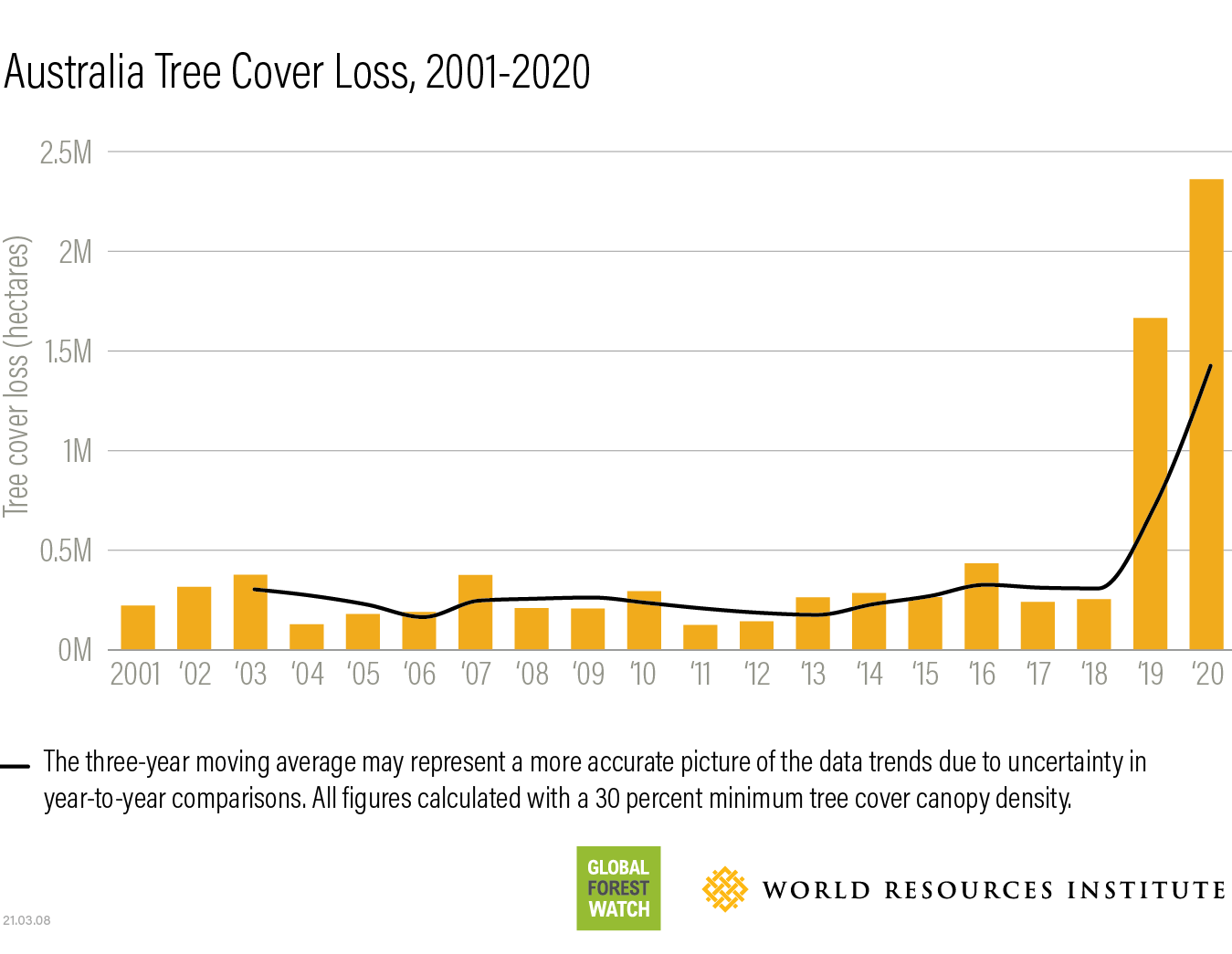
In Commonwealth of australia, fires from late 2019 and early 2020 resulted in a ix-fold increase in tree encompass loss in 2020 compared to 2018. Extreme weather was backside the spike, with climatic change likely to make fire-decumbent conditions more common in the future.
Russian federation besides saw high rates of tree cover loss in 2020, in large part due to fires in Siberia. Siberia experienced abnormally high temperatures in the bound and summer of 2020, probable due to climate change, which dried out forests and led to massive burning. Fires too burned within carbon-rich peatlands that are usually frozen, resulting in record carbon emissions that will exacerbate climatic change.
In contrast, Canada had an unusually tranquility fire year, resulting in a 45% decrease in tree cover loss compared to 2019. Experts cite a combination of factors to explicate the lack of fires, including cooler, wetter weather and restrictions on fires and off-road vehicles during COVID-nineteen lockdowns.
Other natural factors were too at play in 2020. In Nicaragua, forests showed damage from Hurricanes Eta and Iota, which both made landfall in Nov 2020. The hurricanes were role of the Atlantic Ocean's nigh active hurricane season on record, with climate change likely playing a role in the intensity of the storms and the longer-than-usual season.
Finally, Cardinal Europe saw unprecedented levels of tree cover loss in 2020 and the yr prior, with 3-fold increases in Germany and Czech Republic compared to 2018. The spike is in big part due to damage from bark beetles, which have caused item damage to vulnerable trees as a upshot of hot and dry weather associated with climate change.
The hereafter of forests will depend on the actions taken today
The new information makes it clear that nosotros keep to lose forests at a staggering rate and that many wood-related targets with 2020 deadlines were missed.
The situation is increasingly urgent: the effects of climate change are already being felt, countless species are being lost to the extinction crisis, and woods immigration linked to land-grabbing is having irreversible impacts on the rights, livelihoods and cultural heritage of numerous forest peoples.
Indonesia and Malaysia provide reasons for optimism, but the situation in Brazil and elsewhere shows that high deforestation rates tin can return if forest protection efforts are not sustained. Initiatives to rebuild economies in the backwash of the coronavirus pandemic offer an opportunity to reimagine policies and economies in a fashion that protects forests before it's too late.
Source: https://wri-indonesia.org/en/blog/primary-rainforest-destruction-increased-12-2019-2020
0 Response to "what is the long-term consequence if we continue to cut down on the forest?"
Postar um comentário